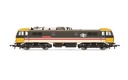
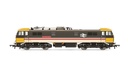
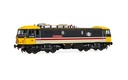
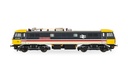
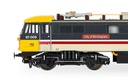
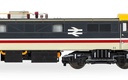
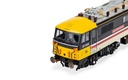
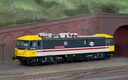

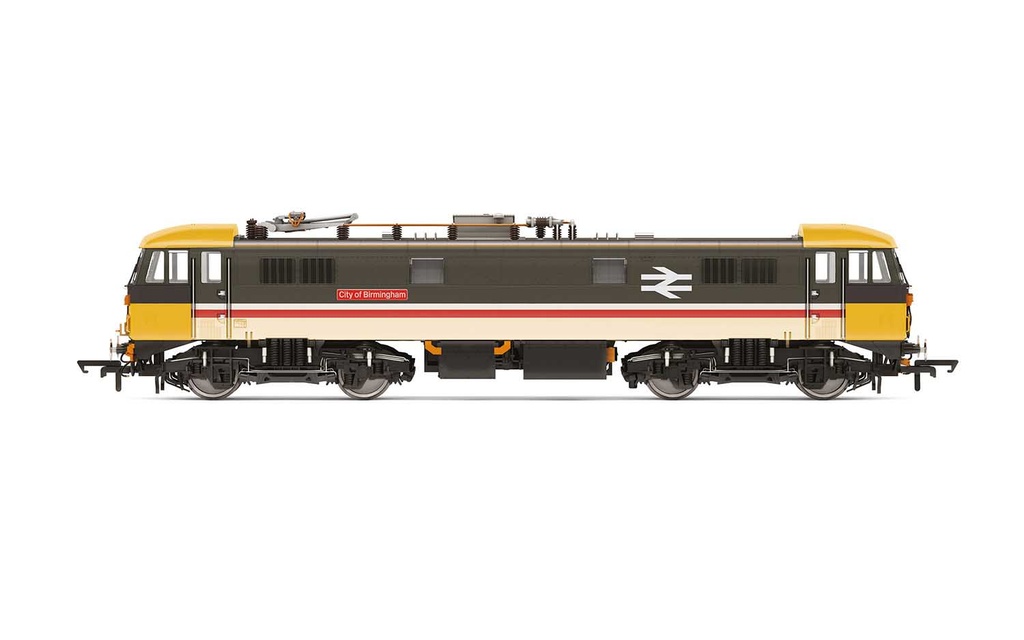
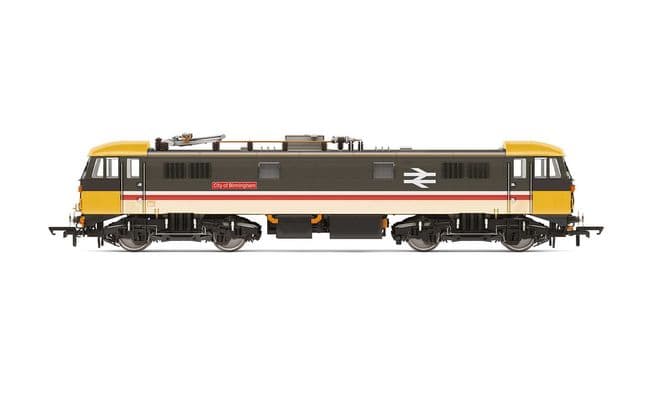
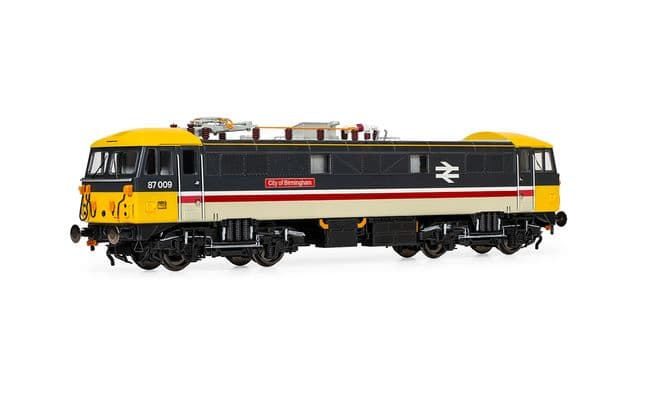
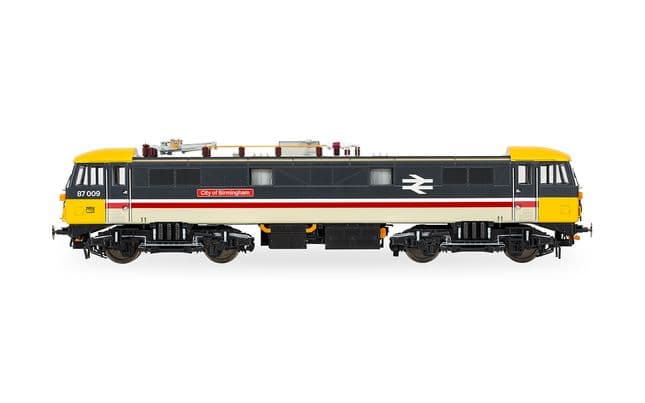
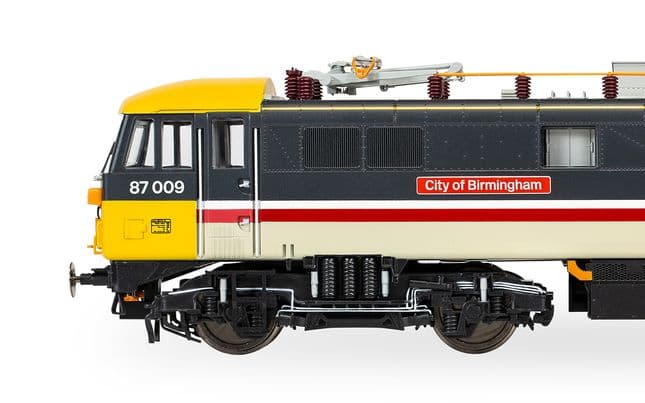
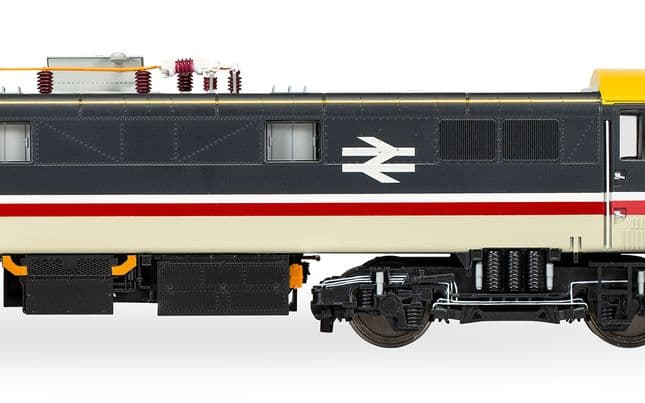
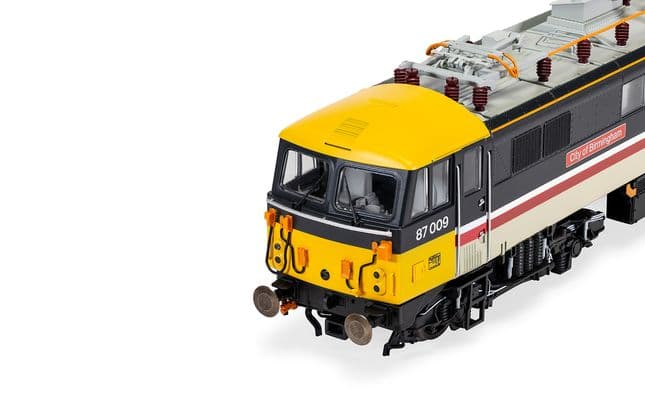
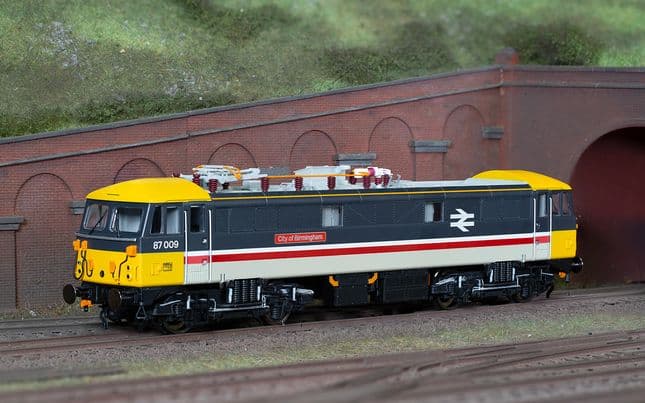
The Class 87 locomotive design resulted from a requirement for a more powerful mixed traffic electrical locomotive by British Rail, needed to cope with the route gradients of the West Coast Main Line between Weaver Junction and Glasgow.
Electrification had been newly authorised over this section in 1970 and was scheduled for completion by May 1974, leaving little time to design a completely new locomotive from scratch and so British Rail decided to base the new class on the existing Class 86 locomotives. The British Railways Board placed an order for thirty four locomotives, later to be increased to thirty six, with British Rail Engineering Ltd at Crewe, GEC Traction providing the electrical equipment. Designed from the outset to work in pairs, as well as in parallel with the Class 86 fleet, the Class 87 was broadly similar to the Class 86 in terms of layout and styling, but mechanically it was a very different.
Immediately identifiable by its new twin windscreen cab, multiple-unit control cables and a redesigned BP9 bogie with Flexicoil suspension, the new locomotives were assembled during 1973-74 and were geared for 110mph running on the WCML, being able to haul 450 ton passenger trains, or 750 ton freight trains single handed. With a power rating of 5000hp, they were to be the most powerful locomotives to run under British Rail until the late 1980s. The first locomotive, 87001, entered traffic in June 1973, the remainder of the fleet being deployed in the general West Coast pool as they entered service, operating Euston to Preston services as the WCML's electrification spread north.
On April 22, 1974 the new West Coast 'Electric Scot' service was introduced, marking a major launch for the class and journey times from London-Glasgow were cut to just five hours. When British Railways reversed its locomotive naming policy in 1977, the class were given the generic title of 'Royal Scot' and named from a selection of famous steam hauled predecessors.
Sectorisation of the railways in the late 1980s/early 1990s meant rail freight operations were wound down and the fleet were engaged solely on passenger services. Following complete privatisation in the mid-1990s, Porterbrook leasing took over ownership of the fleet, but the introduction of the Pendolino trains led to the Class 87s being withdrawn from the core InterCity routes and complete withdrawal began in 2003, with 87016 being the first to be dismantled in November 2004. The last mainstream locomotive hauled service took place on June 10, 2005 and Porterbrook began to look at how best to employ the locomotives, spells with DRS, Cotswold Rail and First GBRf ensuing.
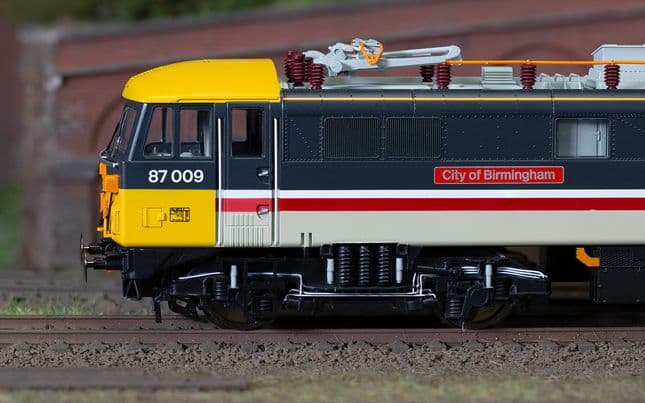
The fleet, not being fitted with On Train Monitoring and Recording (OTMR) could not operate beyond January 1, 2008 and were finally withdrawn from service, some going to Bulgaria between 2008 and 2012. No. 87009 entered traffic in November 1973 named 'City of Birmingham'. In 2012, 87009 was exported to Bulmarket, Bulgaria.
Welcome to the HM7000 Control System
HM7000 is an innovative way of controlling and operating model railways. Combining Bluetooth® technology and app-based control, the HM7000 Control System has been designed to revolutionise the controlling of a model railway.
Learn more
play video
close modal
pause video
Bluetooth
®
Connectivity
Free Sounds
Quick CV Editing
Multiple Control Options
40+ Profile Settings
Other Options
Upgrade Paths
Previous Control Systems can be upgraded to HM7000, see below for the options and upgrade paths available.
Train Set > HM7000
Already have a locomotive but want to go digital? Click here to discover how.
HM6000 > HM7000
The HM6000 system is only a short step away from having HM7000. Click here to discover how.
HM|DC > HM7000
New to the hobby? HM7000 is just a short step away. Click here to discover how.
DCC > HM7000
Already operating a layout using DCC? HM7000 is just a short step away. Click here to discover how.
Conventional DCC Controller > HM7000
Locomotives fitted with either a Hornby HM7000 or conventional decoders can be operated using the HM|DCC Bluetooth® system - click here to learn how.
HM7000 Products
HM7000-6: Bluetooth® & DCC Decoder (6-pin)
R7321 |
star - filled
star - empty
(13)
Contenido
1x Model Electric Locomotive, 1x Accessory Pack (includes etched nameplates, jumper cables and coupling hook and bar), 1x Instructions
Especificaciones
| Escala | 1:76 |
| Curva mínima | Radius 2 |
| DCC | DCC Ready 21 pin socket |
| Motor | 5 pole skew wound |
| Compañía ferroviaria | British Railway |
| Longitud sin embalaje (cm) | 24.3 |
| Altura sin embalaje (cm) | 5 |
| Anchura sin embalaje (cm) | 3.5 |
| Peso sin embalaje | 0.57 |
| Licencia | No |
| Número de piezas | 1 |