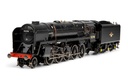
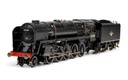
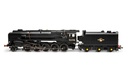
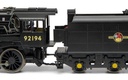
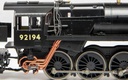
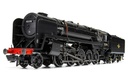
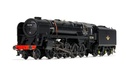
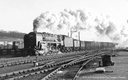
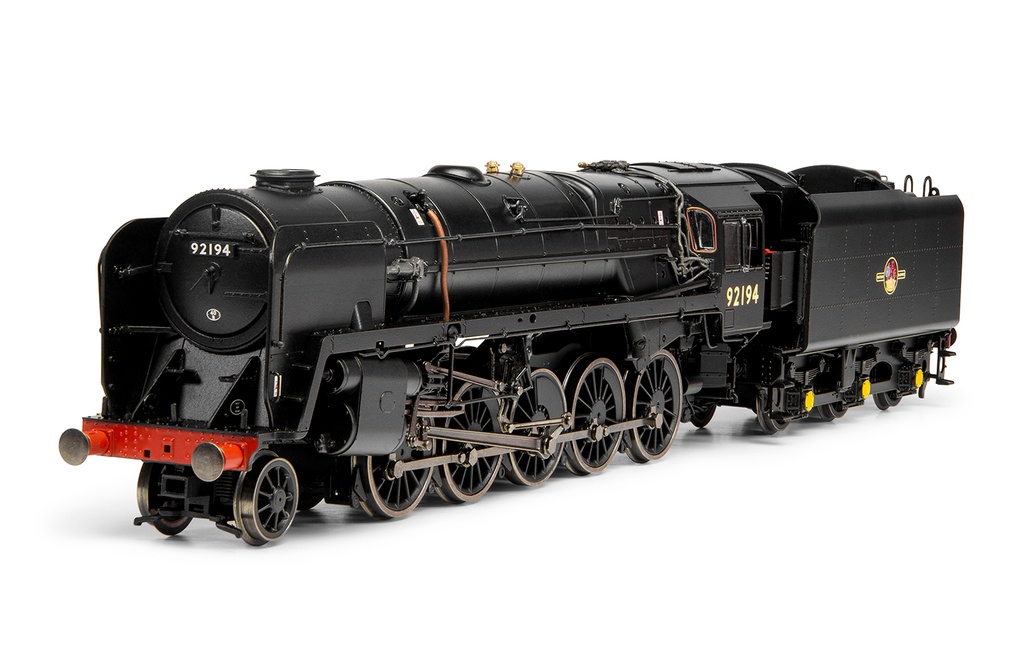
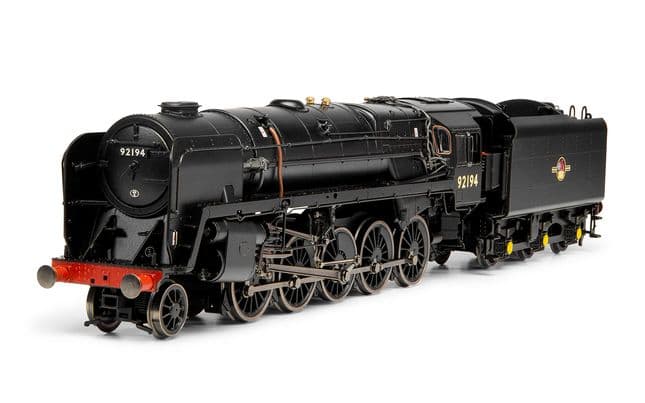
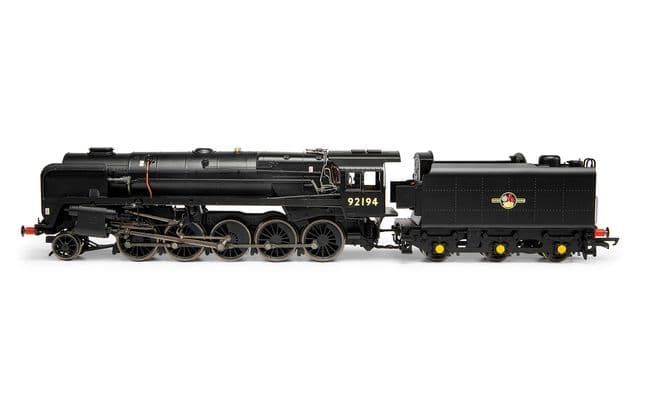
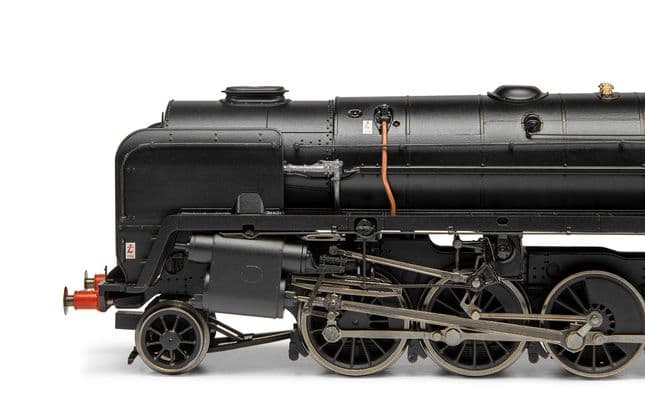
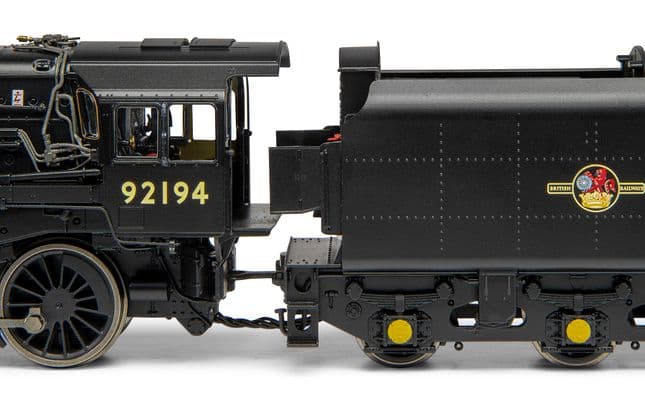
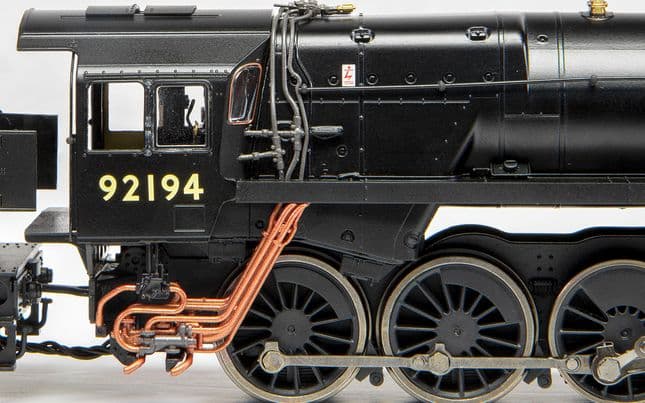
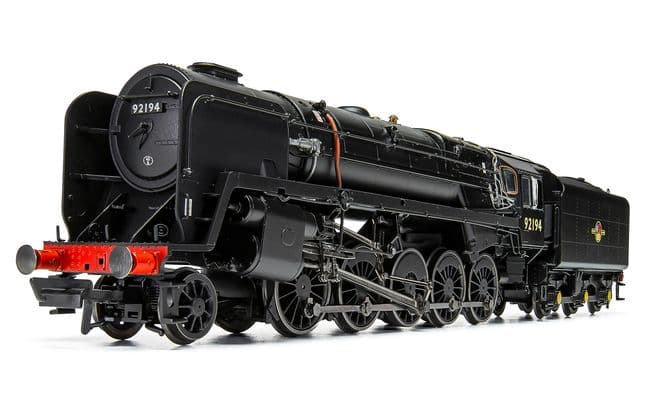
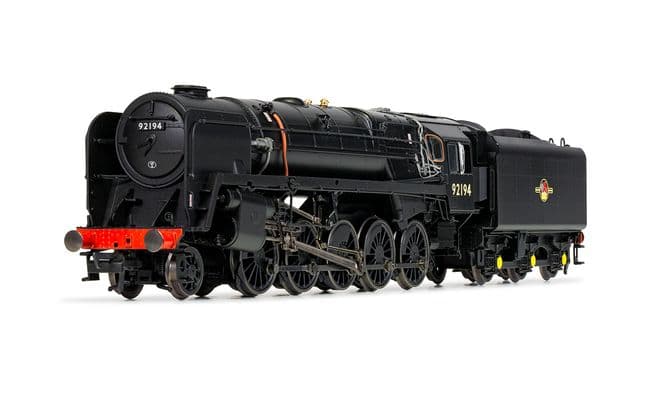
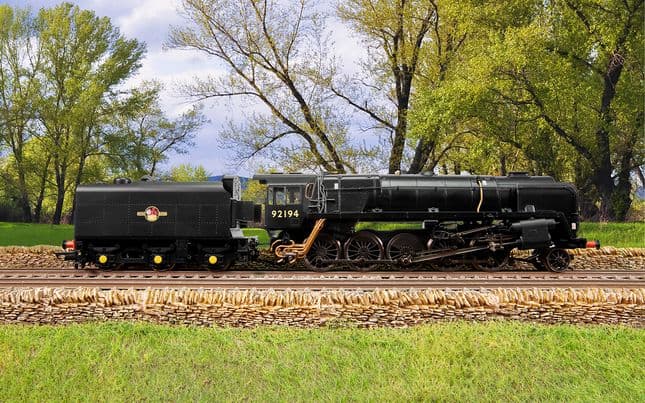
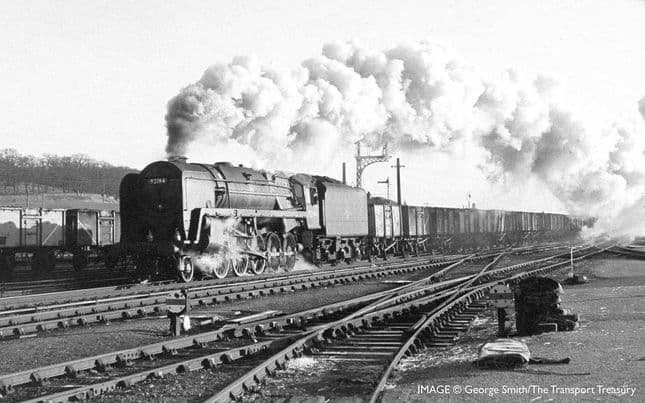
The British Railways Standard 9F Class was a 2-10-0 steam locomotive, the last of the standardised BR designs. The Robert Riddles design was intended as a long distance heavy express freight locomotive. In total 251 of the class were produced between January 1954 and March 1960, with the final locomotive No. 92220 'Evening Star' being the last steam locomotive built by British Railways.
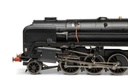
The huge length of the 10 coupled driving wheels proved problematic when faced with tight curves, a situation that freight haulage would make inevitable. A solution was found by removing the flanges from the centre driving wheel and reducing the size on the flanges on the second and fourth driving axle's wheels. Riddles had chosen the 2-10-0 wheel configuration in-order to spread the load of the boiler over a greater area. This meant that the boiler had to be raised considerably compared to other designs to allow the firebox to sit above the trailing driving wheels. As a result, the 9F features a distinctive void between the suspended boiler and the footplate.
In operation the class proved extremely versatile. Not only did the 9F excel as a freight locomotive, but when required it also succeeded as a passenger locomotive. Reports even suggest that when 92220 'Evening Star' was used to pull the Red Dragon express service between Cardiff and London it was forced to delay its arrival to allow the restaurant services to be completed, having outperformed the normal Britannia Class locomotives used on the service. This was not the only time 9Fs had been recorded outperforming dedicated express locomotives and on such services the locomotives were capable of running at over 90mph. This combination of high speed, fast acceleration and powerful hauling capabilities mean that many consider the class to be pinnacle of British steam locomotive design.
Locomotive No. 92194 was built in Swindon during 1958 for use on the Eastern Region. The locomotive was initially allocated to the Doncaster shed where it spent around 8 months between June 1958 and February 1959 at which point it was reallocated to Immingham. Immingham remained the locomotive's home throughout the rest of its service before withdrawal at the end of 1965, a life of just 7 and a half years.
Welcome to the HM7000 Control System
HM7000 is an innovative way of controlling and operating model railways. Combining Bluetooth® technology and app-based control, the HM7000 Control System has been designed to revolutionise the controlling of a model railway.
Learn more
play video
close modal
pause video
Bluetooth
®
Connectivity
Free Sounds
Quick CV Editing
Multiple Control Options
40+ Profile Settings
Other Options
Upgrade Paths
Previous Control Systems can be upgraded to HM7000, see below for the options and upgrade paths available.
Train Set > HM7000
Already have a locomotive but want to go digital? Click here to discover how.
HM6000 > HM7000
The HM6000 system is only a short step away from having HM7000. Click here to discover how.
HM|DC > HM7000
New to the hobby? HM7000 is just a short step away. Click here to discover how.
DCC > HM7000
Already operating a layout using DCC? HM7000 is just a short step away. Click here to discover how.
Conventional DCC Controller > HM7000
Locomotives fitted with either a Hornby HM7000 or conventional decoders can be operated using the HM|DCC Bluetooth® system - click here to learn how.
HM7000 Products
HM7000-6: Bluetooth® & DCC Decoder (6-pin)
R7321 |
star - filled
star - empty
(13)
Contenido
1x Model Steam Locomotive, 1x Instructions
Especificacions
| Compañía ferroviaria | BR, BR black |
| Escala ferroviaria | OO |
| Escala | 1:76 |
| Curva mínima | Radius 2 |
| Color (informativo) | Black |
| DCC | DCC Ready 21 pin socket |
| Motor | 5 pole skew wound |
| Longitud sin embalaje (cm) | 26.6 |
| Altura sin embalaje (cm) | 5 |
| Anchura sin embalaje (cm) | 3.5 |
| Peso sin embalaje | 0.43 |
| Licencia | No |
| Acabado | Painted |
| Número de piezas | 1 |